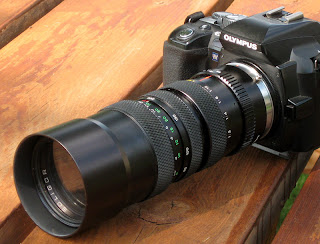
I picked up a used Olympus Evolt E-500 a few years back. At 8 mega-pixels, it offers plenty of image size for my needs. I don't make money with my cameras, I document my family life with it. Works great.
One thing the E-500 has is the ability for me to mount vintage optics on it by means of an adapter. That formed one of the prime reasons for its purchase. With all my vintage film equipment about, it was natural to want to mount some cool old lens on my DSLR.
I've played with mounting all my Olympus OM system lenses. Some results are great (like the 50mm f/3.5 macro), some not so much. The 4/3rds sensor doubles the magnification of whatever old lens I place in front of it. My 500mm f/8 Tokina becomes a whopping 1000mm f/8 just like that. But all those wideangle lenses become either "normal" lenses or "portrait" length lenses. No matter, it's all fun.
![]() |
| Soligor two-touch 85-205mm zoom lens |
The Soligor was never designed to go head-to-head with a Nikon, Canon or other OEM lens as far as resolution. Manufactured by a third party and badged with the Soligor name (a brand name by the American distributor AIC, Allied Impex Corporation), it did a fine job for those folks who could not afford OEM lenses.
Once you mount a non-digital lens, like the Soligor, on the E-500, you're left with aperture-preferred automation. You set the lens to an f-stop, and the camera selects the correct shutter speed. And just like it was done around 1963, as you move the aperture ring on the lens, the light is reduced through it. So, you compose and focus at full aperture, then stop-down to shoot. Can get really dark in that viewfinder. This combination of camera and lens is best left to non-moving subjects that afford you the time to do all this fiddling.
![]() |
| Flowers shot at about five feet away. |
But the Soligor has a, um, vintage look about it's images. The contrast is much lower. After all, when you processed film and made prints, contrast got added as a natural part of photo-processing. Maybe it's a modern sensor/ancient optics issue. Maybe it's just a crappy old lens.
No matter. This is fun. I'm gonna do it again with some other piece of glass to see what happens.
If you've got a DSLR that can accept older lenses via an adapter, try it out. You'll find you get WAY more involved in taking a photo, even (horrors!) planning each one out before you shoot. You'll chimp each shot less as you concentrate on the viewfinder more.